ORC turbines: electricity from waste heat
An ORC (Organic Rankine Cycle) turbine turns waste heat from about 85 °C upwards into electricity. DCS Cleantech delivers and services BITZER Group ORC units from BPOWER in Finland, Sweden and the Baltic states, for engines, boilers, steam and flue gas. Single units deliver up to 180 kW and can be cascaded for larger sites.
ORC in brief
- What it does: an ORC unit converts low-temperature heat into electricity. Typically 5–20 % of the heat becomes power, depending on source temperature.
- Minimum heat source: hot water at 85–90 °C or more and about 400 kW of heat. Steam from 105 °C and about 1 MW. Flue gas from 200 °C through a heat exchanger, or from 350 °C direct.
- Two benefits: electricity for your own use, plus a lower cooling load, because the ORC takes over part of the dry cooler’s work.
- Technology: ElectraTherm and Triogen units, supplied through BPOWER a.s., a BITZER Group company with more than 300 ORC systems installed worldwide.
- Delivery: DCS is your local project partner in Finland, Sweden and the Baltic states. Typical lead time is 6–9 months plus 2–4 weeks of commissioning.
Updated: September 2026. Figures are indicative; every site is sized from measured data.
How does an ORC turbine work?
An ORC works like a steam turbine, but with an organic working fluid that boils at a much lower temperature than water. That lets it run on heat of 85–150 °C, which is too cold to drive a steam turbine economically.
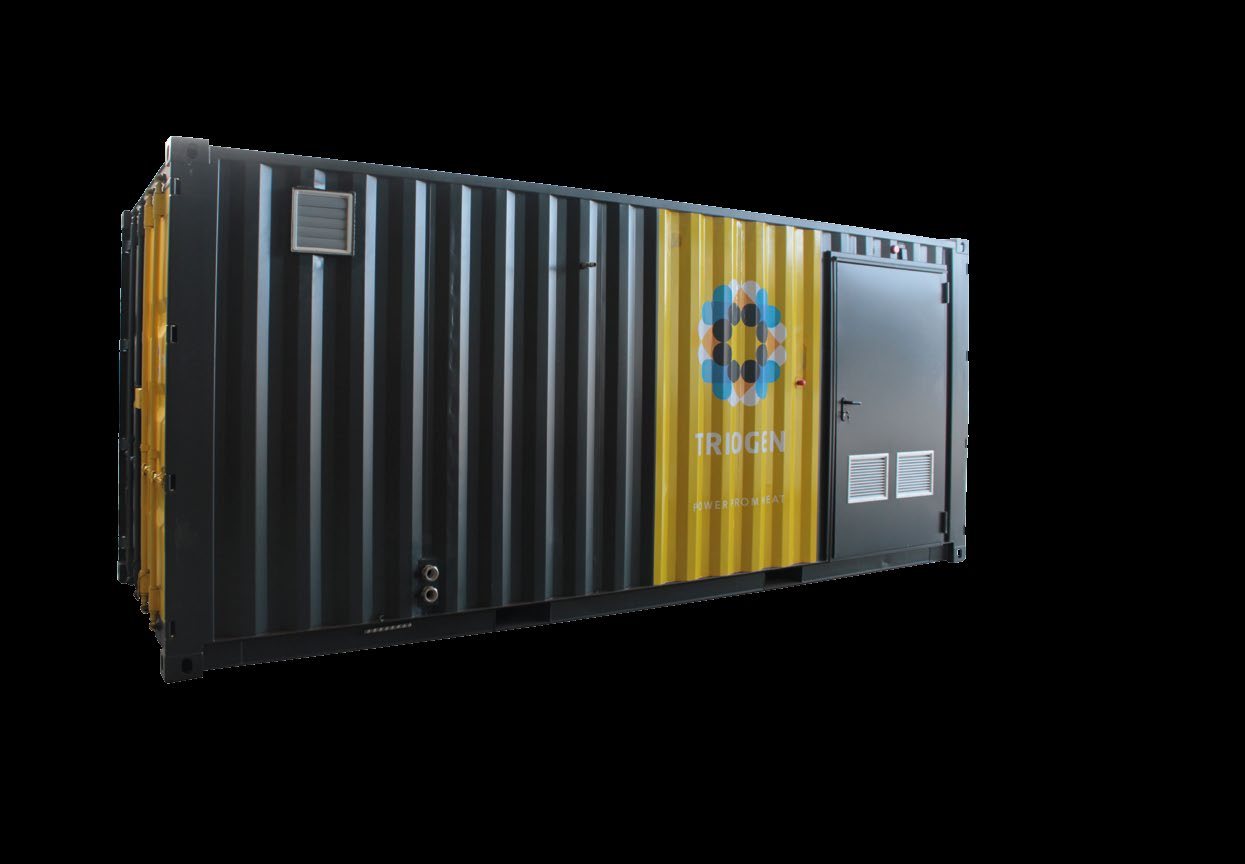
The loop is closed and burns no fuel, so the ORC adds no emissions on site. Working fluids include R1233zd(E), a low-GWP refrigerant, in ElectraTherm units, and toluene in the Triogen e-box.
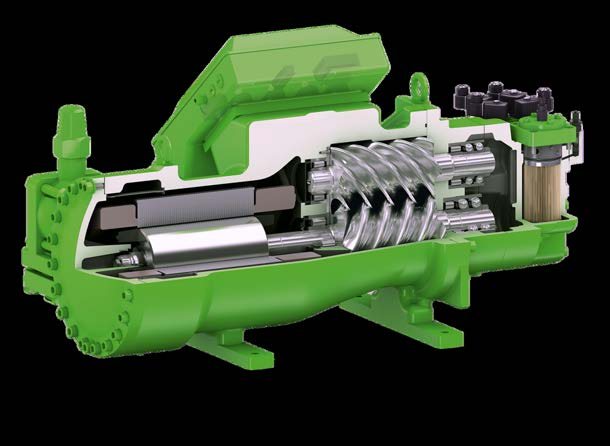
1
Pump
The liquid working fluid is pumped to high pressure.
2
Evaporator
Waste heat boils the fluid into pressurised vapour.
3
Expander and generator
The vapour drives a twin-screw expander (ElectraTherm) or a high-speed radial turbine (Triogen), which turns a generator.
4
Condenser
A cooler condenses the vapour back to liquid, and the cycle repeats.
Is your heat source suitable for ORC?
Three numbers decide it: temperature, the amount of heat and hours per year. Rules of thumb from BPOWER:
| Heat source | Minimum temperature | Minimum heat | Typical ORC line | Note |
|---|---|---|---|---|
| Hot water, engine jacket water | 85–90 °C | about 400 kW, flow about 4 l/s or more | ElectraTherm Power+ | Direct connection; simplest and usually the cheapest install |
| Steam or condensate | 105 °C, or lower if still pressurised | about 1,000 kW | Hot-water ORC + steam/water heat exchanger | Condensing steam has the largest energy potential |
| Flue gas through a heat exchanger | 200 °C | about 1,000 kW | Hot-water ORC + flue-gas heat exchanger | Heat exchanger cost drives the economics; measure first |
| Hot exhaust gas, direct | 350 °C (up to about 530 °C) | about 500 kW when cooled to 180 °C | Triogen e-box | Engine exhaust, gas turbines, process off-gas |
Heat should be available most of the year; ElectraTherm puts suitable sites at about 80 % uptime, roughly 7,000 hours a year. Low-temperature, low-flow flue gas from ordinary hot-water and steam boilers is usually not enough. Below these limits, a heat pump or MVR system is often the better choice.
Where is ORC used?
Examples are BPOWER references.
Gas and biogas engines
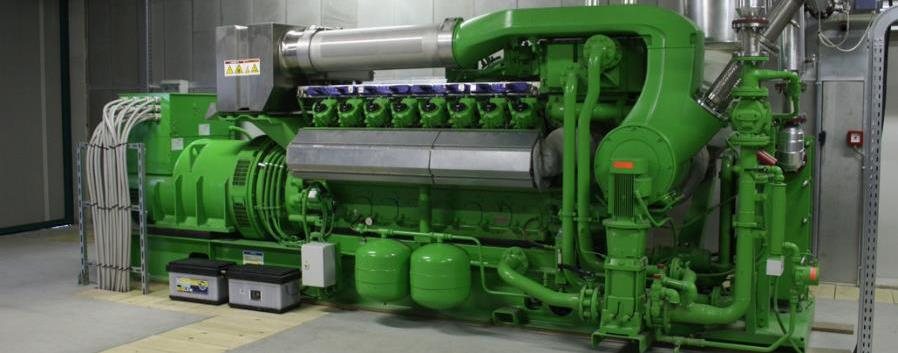
From about 400 kWe engine size, at biogas plants, wastewater treatment plants, landfills and gensets. Jacket water feeds a hot-water ORC; exhaust gas feeds a Triogen e-box.
Example: a 1.5 MW biogas engine gives about 35 kWe from jacket water (Active Cooler AC800) and about 120 kWe from exhaust gas (Triogen).
Biomass and district-heating boilers
Hot water at 90–150 °C, or hot-air boilers up to 530 °C. Useful when heat demand drops in summer.
Example: an ElectraTherm unit on a wood-industry biomass boiler, 92 °C water, 30 kWe.
Steam and condensate
Food processing, drying and rendering plants, and steam plants with condensing limits.
Example: a rendering plant turns 3.7 MW of drying-room steam into 272 kWe (4 × 63 kWe plus 20 kW of cooling savings).
Industrial cooling loops
Melting furnaces, waste incinerators, acid cooling in chemical plants, insulation manufacturing.
Process flue gas
Paint-shop afterburners, aluminium and melting plants, cement kilns, crematories.
Example: two cremation lines, 100/85 °C water, 740 kW of heat, 44 kWe net plus domestic hot water.
Trigeneration
ORC plus an absorption chiller gives power, heat and cooling from one source.
Example: four paint-shop lines, about 1.6 MW of heat, give 70–90 kWe, 1.4 MW of heat and 1.2 MW of cooling.
Data centres and gas-turbine plants
An ORC on turbine or engine exhaust adds power without adding fuel. BPOWER calculates 25 instead of 30 gas turbines for the same output, at 16.6 % net ORC efficiency.
Our ORC range
Four product groups from BPOWER, BITZER Group.
Hot-water ORC
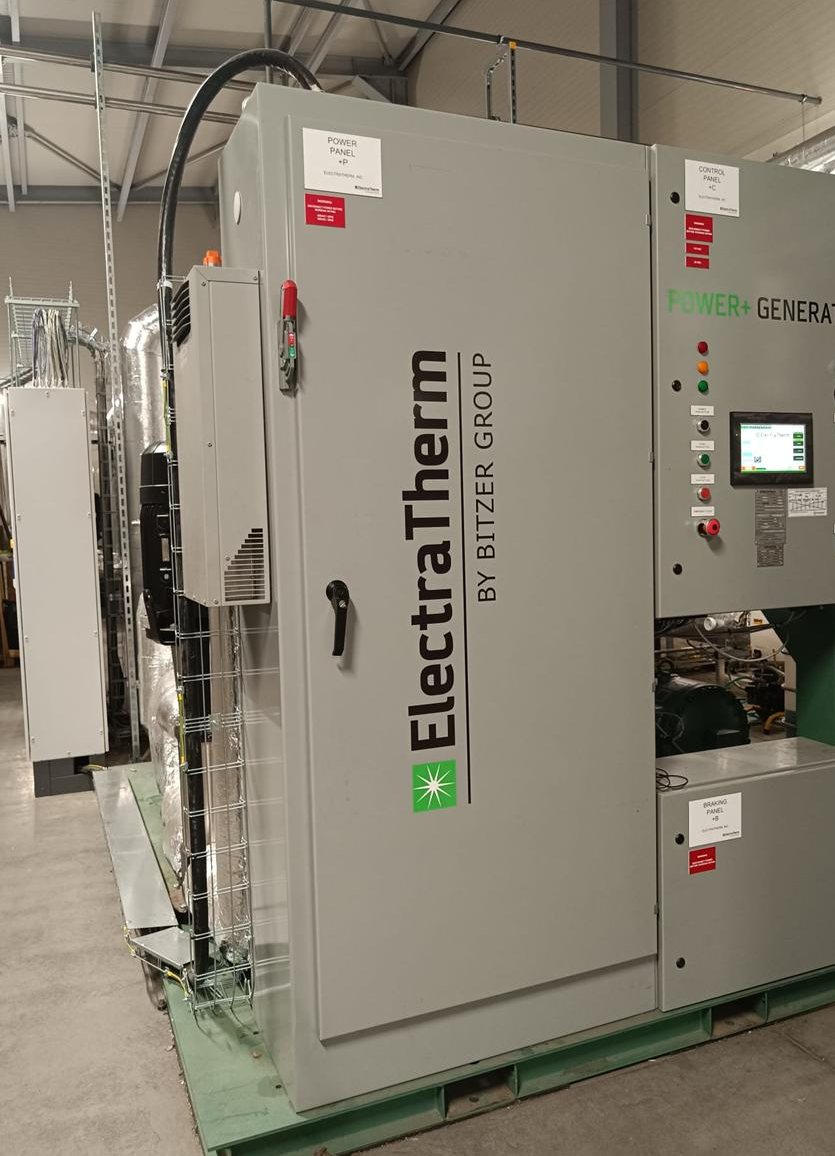
ElectraTherm Power+ PM75 and PM150 for 65–150 °C hot water. Up to 125 kWe per unit at 50 Hz.
Cooling-to-power
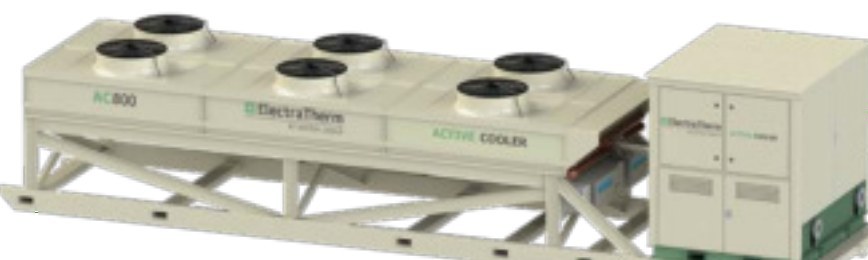
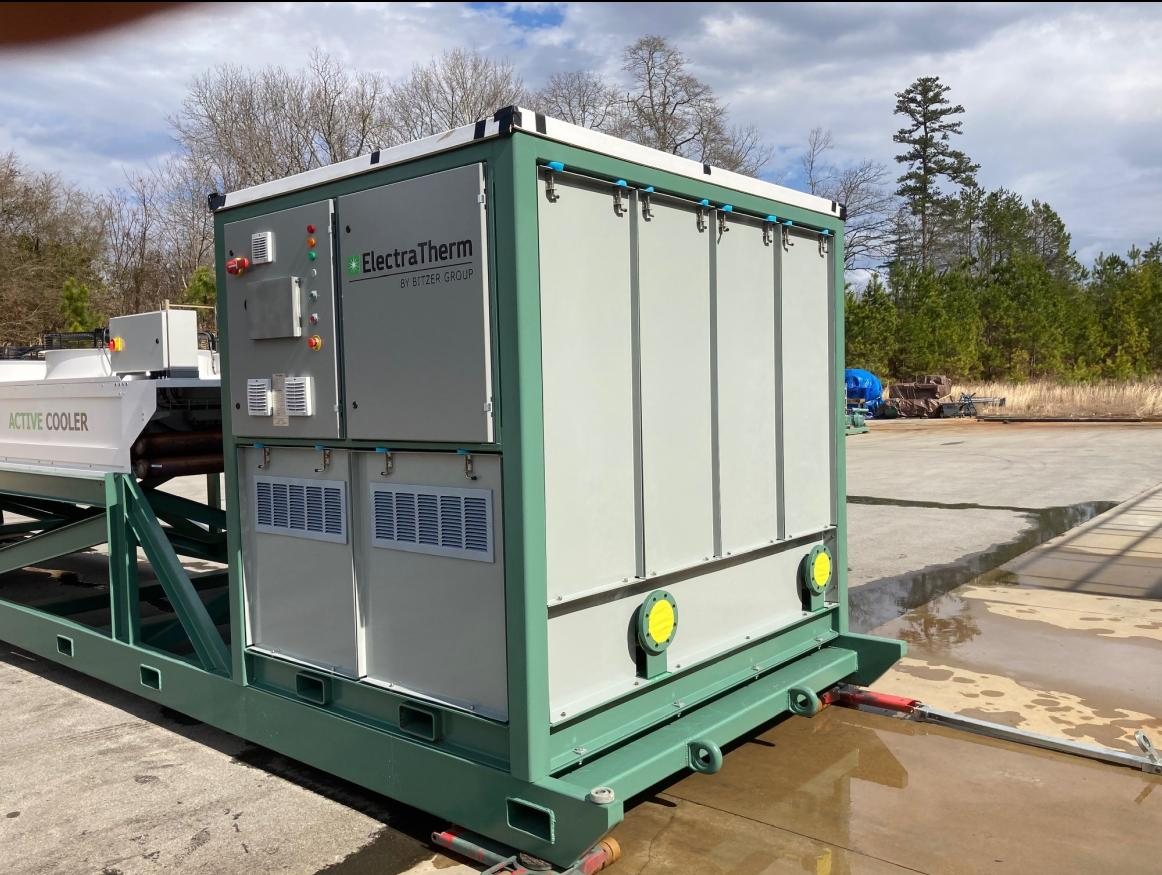
ElectraTherm Active Cooler AC800 cools up to 800 kW and generates up to 75 kWe.
Heat rejection and absorption cooling
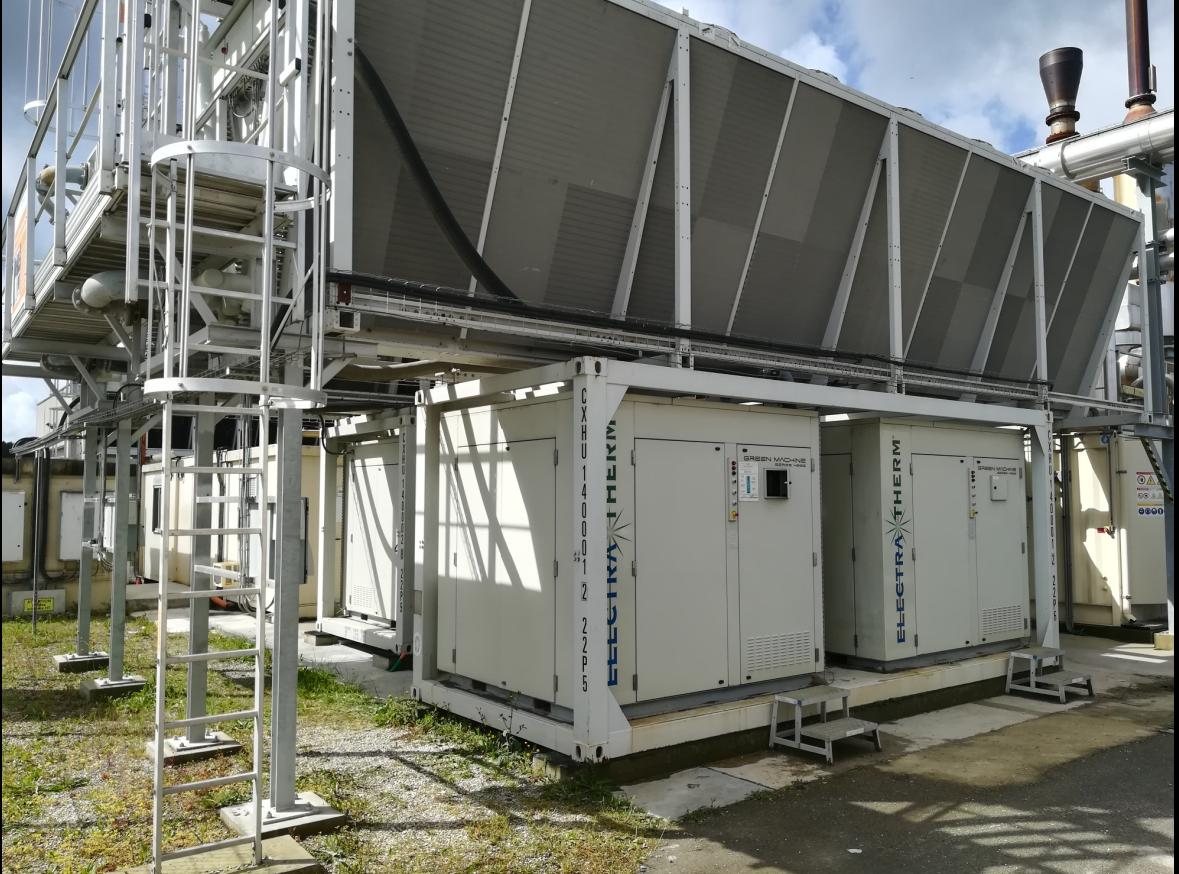
Dry coolers sized for each ORC, and absorption chillers for power, heat and cooling from one source.
How does an ORC project run?
- Heat-source data: you send the medium, temperature, flow and annual operating hours. You get back a preliminary technical and price estimate.
- Measurement and feasibility study: temperatures, flows and pressures are measured on site. The study covers solution variants, P&ID, a detailed budget quotation and a payback model. This step is paid, and it gives both sides reliable numbers before the investment decision.
- Delivery: engineering, supply, installation and commissioning. Typical lead time is 6–9 months, plus 2–4 weeks of commissioning.
- Service: a 24/7 support line, remote monitoring and local service in Finland, Sweden and the Baltic states. BPOWER services more than 200 ORC plants in Europe.
What data do we need from you?
- The heat source, what it is used for today, and how and at what cost it is cooled now.
- Water: temperature in and out, and flow (l/s or m³/h).
- Steam: pressure, temperature and amount (t/h), and where it condenses.
- Flue gas: flow, temperature, lowest allowed outlet temperature (dew point) and how dirty the gas is.
- Whether the source is stable or variable, and how many hours a year it runs.
- Your electricity price and on-site consumption.
- Photos of the connection points and the free space around them.
References
BPOWER and BITZER Group references abroad:
| Site | Heat source | Technology | Result |
|---|---|---|---|
| Pohnpei, diesel power plant | 3 diesel gensets, 2,000 kW hot water | ElectraTherm | 140 kWe plus 120 kW saved on engine cooling |
| Dubai, diesel gensets | Exhaust gas, 990 kW | Triogen | 180 kWe |
| Alon Tavor CHP plant, Israel | Condensate 110/94 °C, 3,650 kW | ElectraTherm | 125 kWe plus extra cooling |
| Rendering plant | Drying-room steam, 3.7 MW | ElectraTherm, 4 units | 272 kWe including cooling savings |
| Biogas plant | 1.5 MWe engine exhaust, 750 kW | Triogen | 120 kWe |
ElectraTherm’s 2023 reference list shows Power+ units in continuous operation on biogas engines and biomass CHP plants in the UK, Czech Republic, Germany, Austria and Japan.
Why DCS Cleantech?
- Local project partner: one contact from the first data sheet to service, for a BITZER Group technology.
- Heat and flue-gas know-how: more than 40 years in industrial fans, dust control and flue-gas cleaning, so we know how dirty, hot gas behaves in a heat exchanger.
- Own workshop in Voikkaa: ISO 9001 quality system and ISO 3834-2 welding certification for piping, steelwork and skids.
- Electrification in the same house: ORC, heat pumps and MVR, and electric boilers, so we can compare the options for your heat impartially.
Frequently asked questions
What is an ORC turbine?
An ORC (Organic Rankine Cycle) unit is a closed-loop heat engine. It uses an organic working fluid that boils at a low temperature, so heat from about 70–530 °C can drive an expander or turbine and a generator. “ORC turbine” is the common name. Some units, such as ElectraTherm, actually use a twin-screw expander; others, such as Triogen, use a radial turbine.
How much electricity can I get from waste heat?
Typically 5–20 % of the heat input, depending on temperature. As a rule of thumb, 1 MW of 90–130 °C hot water gives about 40–100 kWe. About 1 MW of 350 °C+ exhaust heat gives up to 180 kWe with a Triogen e-box, at 18.2 % net efficiency. A feasibility study fixes the exact figure from measured data.
What is the minimum temperature for an ORC?
For units built to make power, hot water from about 85–90 °C, and the higher the better. The Active Cooler starts at 70 °C. Steam works from about 105 °C, flue gas from 200 °C through a heat exchanger, and from 350 °C direct. Below 70–80 °C, a heat pump is usually the better tool.
How much heat do I need?
About 400 kW of hot water, about 1 MW of steam or of flue gas through a heat exchanger, or about 500 kW of hot exhaust gas. The Active Cooler works from about 380 kW of heat. The heat should be available most of the year; suitable sites run about 7,000 hours a year or more.
What does an ORC cost, and what is the payback?
Cost depends on the heat source, the heat exchangers needed and the site work. The feasibility study delivers a budget quotation and a payback model. Payback is fastest with long run hours, high electricity prices and a cooling load the ORC can take over. In one ElectraTherm case, an AC800 on a 1.6 MW engine running 8,000 h a year produces 616 MWh a year.
Should I choose an ORC or a heat pump?
If you can use the heat – for district heating, drying or a process – using it directly, or upgrading it with a heat pump or MVR, usually pays best. If the heat is dumped to air through coolers today, an ORC turns it into electricity. DCS supplies both, so the comparison is part of the study.
Does an ORC affect my gas engine?
Triogen states that its exhaust ORC keeps back pressure on the engine below 25 mbar and does not change engine performance, maintenance intervals or warranties. The ElectraTherm Active Cooler can take over engine cooling. If the ORC trips, the cooler keeps cooling in bypass, so the engine does not have to derate.
Can an ORC give both heat and electricity?
Yes. CHP versions return condenser water at up to 90 °C, for example the Triogen e-box CHP at 75/90 °C, so the same unit can feed a district-heating network or a process. Add an absorption chiller and one heat source gives power, heat and cooling (trigeneration).
How long does delivery take, and what maintenance is needed?
Typical lead time is 6–9 months, plus 2–4 weeks of commissioning. ElectraTherm units have a semi-hermetic expander with no shaft seal, remote monitoring and a 20-year design life. Service includes a 24/7 support line, remote access and local support in Finland, Sweden and the Baltic states.
Who supplies ORC turbines in Finland?
DCS Cleantech Oy, based in Voikkaa, is the distributor of BPOWER a.s., the ORC specialist of the German BITZER Group, for Finland, Sweden, Estonia, Latvia and Lithuania. DCS offers ElectraTherm and Triogen ORC technology with feasibility studies, project delivery and service. Contact: sales@dcs.fi, +358 44 730 8110.
Do you have waste heat above 85 °C?
Send us the temperature, flow and operating hours. We will tell you whether an ORC is worth studying.
✉️ Send heat-source data 🎧 Book Teams Appointment
sales@dcs.fi · +358 44 730 8110